
GROW Training
In the first week of March, IVCF offered training for undergraduate staff in how to grow their fellowships, the training was offered in three tiers. I entered the tier 1 training with trepidation, fearful that I would be scolded for not performing as I should and thus given remedial training. But almost immediately my fears were assailed, and I was able to get some good training and take a step back from the work I was doing on campus and see the ministry with new perspective.
We were given new tools to assess growth in our fellowships, and were able to discuss topics with fellow staff in similar contexts as us. I was surprised at how refreshing the training was and look forward to implementing new strategies in the ministry.
Theology of Work
For three consecutive Saturdays, students and staff from across the GTA gathered to be participate in a course designed and executed by my dear friend and colleague, Christa called the Theology of Work. The first week outlined how we define our relationship with work and challenged students to see all work as worship. The second week gave the students some space to assess their spiritual gifts and talents. And the final week gave some practical teaching on giving and stewarding money and power.
Each week we piled into Christa’s apartment and ate brunch as we worked through the content.
The food was delicious, the teaching was sound and the students were challenged. I enjoyed the opportunity to work with my colleagues, as I’ve missed planning and leading events with other staff.
I only had a few of my students attend, but for those who did they really came away with a renewed vision and set of resources.
Pancake Tuesday
Usually when Pancake Tuesday rolls around it goes by uncelebrated. This year however, it fell during winter reading week, and since I knew RA was going to be staying in the city for reading week, I asked her if she wanted to make pancakes with me. This is what we came up with:
Baking pies
One of the first things that I learned about RA, after her love of God and her international student status, is her love of pies. In particular, apple pie; and it became the thing that I and others would bring or make to draw her out to events.
As she stepped deeper into leadership, both with our community and as an RA, I knew one way to spend time with her would be to teach her my pie-making ways.
We started in the fall by making apple pie.
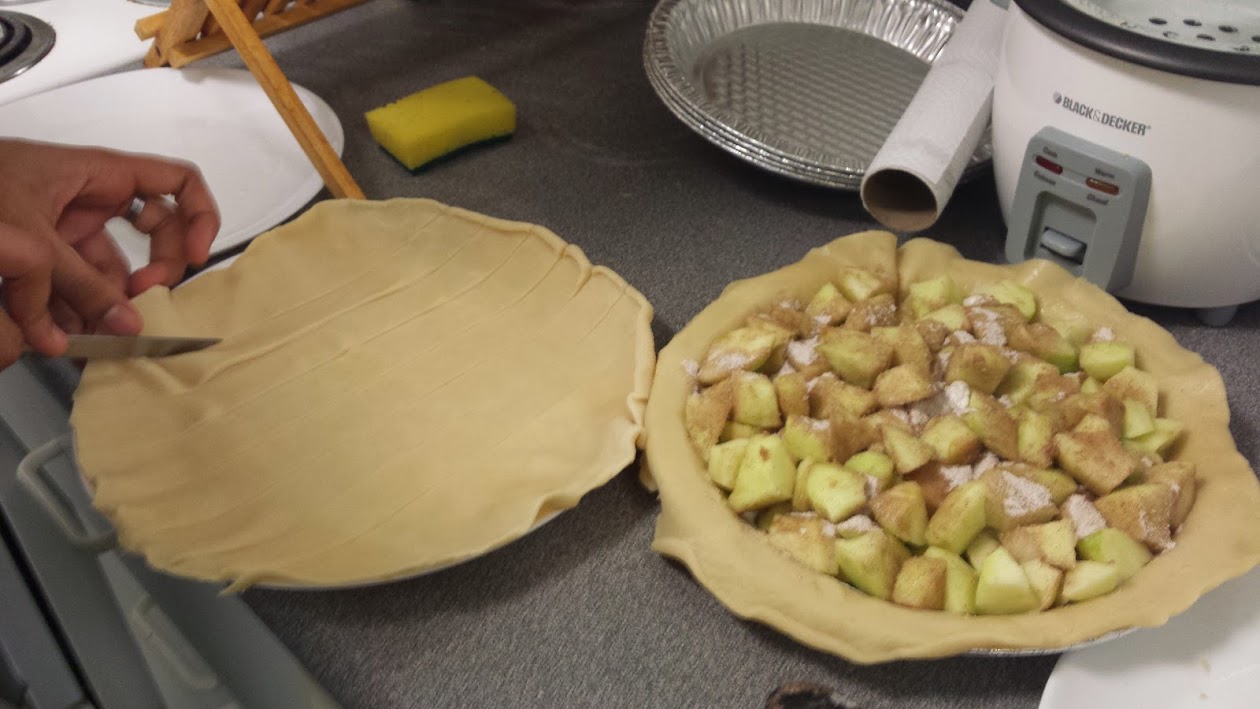
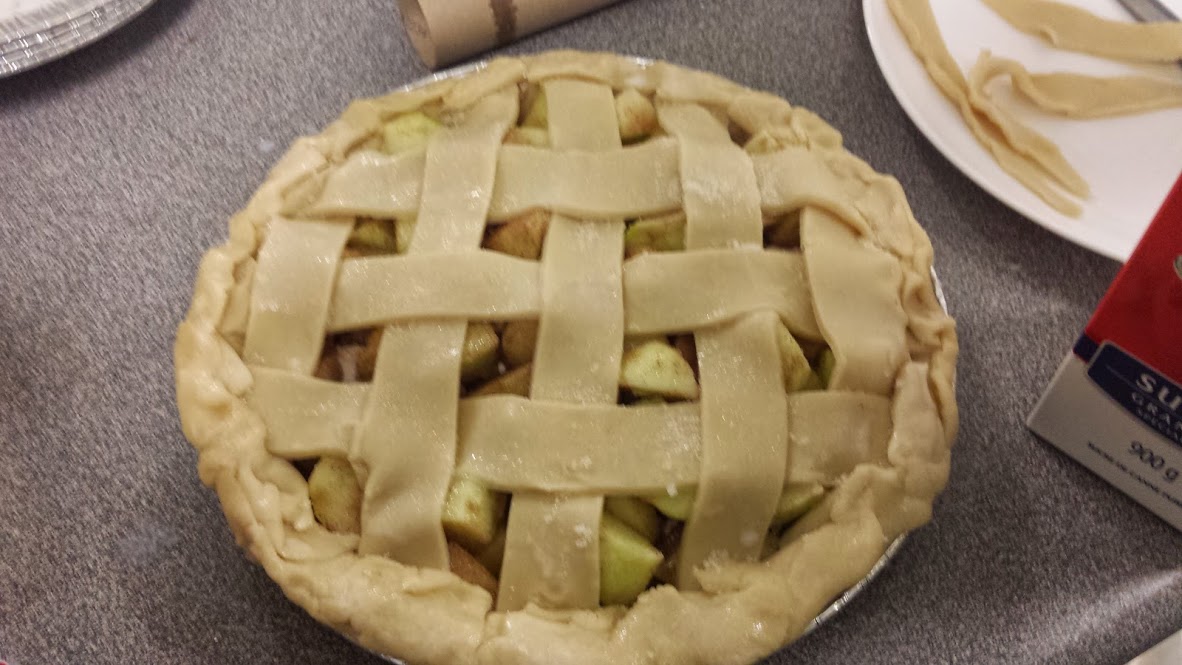
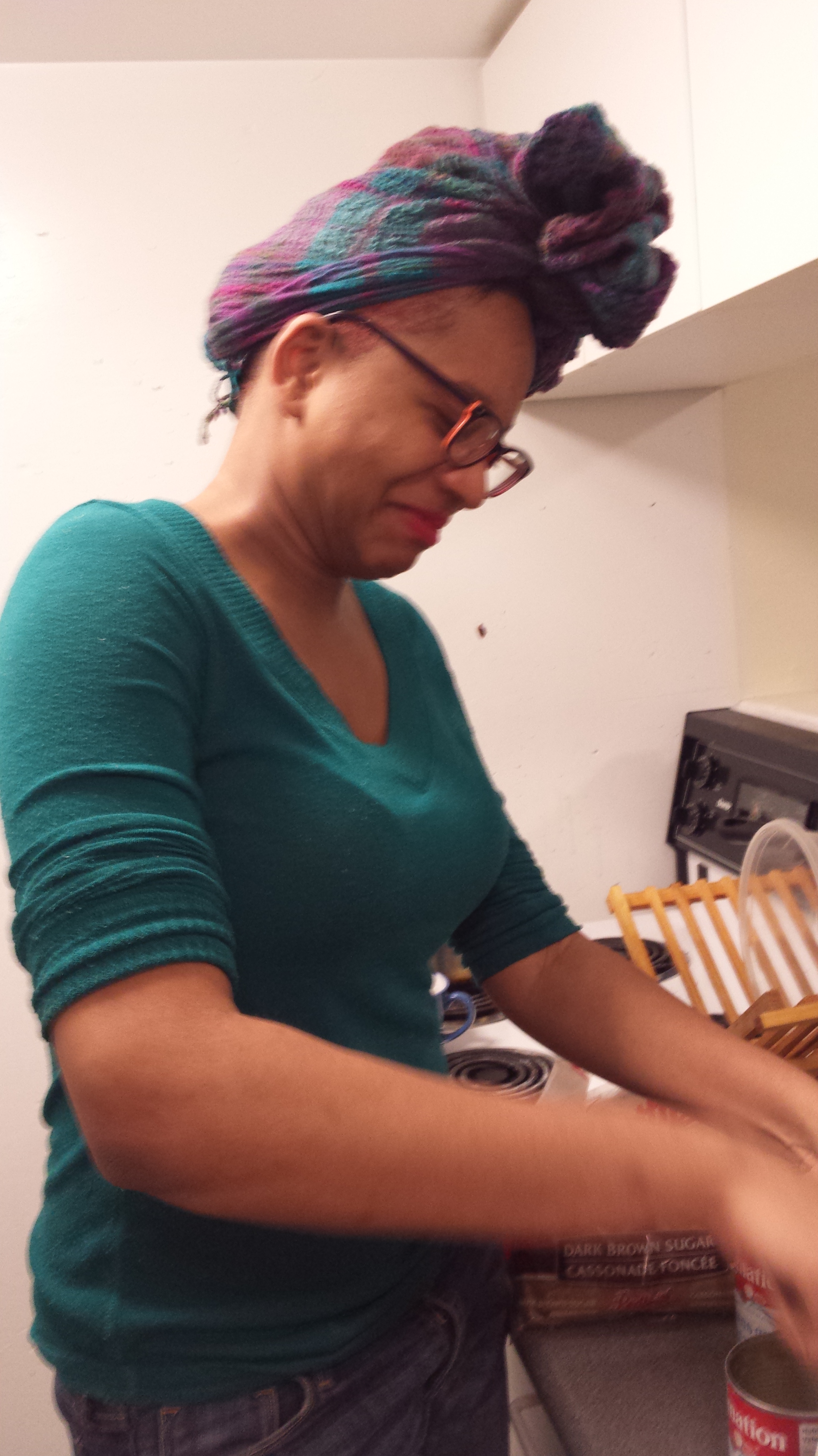
Then we moved on to making pumpkin pie. We baked the pies in her dorm room, set off the fire alarm too many times to count, and filled the hallway with smoke. And what of the pies? To give her credit, I admit pumpkin pies look pretty gross before you bake them, and this face really says it all.
But after all the drama we spent some time discussing RA’s wall collage that depicted how beauty is depicted in the media, and how diversity in terms race, ethnicity, and physical imperfections is minimal; and how that affects us as women of colour.
Before we knew it, the pies were done, and though they looked gross going in, they tasted delicious coming out of the oven. But don’t just take my word for it.

Yeast starter: Part 2
“Well,” she paused and broke into a big toothy grin before continuing, “about that…”
On the day of the first study where we would introduce the yeast starter application activity, I had a previous speaking engagement. I was set to speak to the Mission Circle at my dear friend Bonnie’s church, and I would completely miss that afternoon’s study.
Now, as you can probably guess from my previous post, I was pretty excited about the whole yeast starter both in its actuality and the ways it could foster a culture of hospitality (I’d have to be in order to endure those 10 days). But I had to sell my bible study leaders on it. Most were not bakers or scientists so my whole “It’s cooking science!” exclamations didn’t really captivate them. I eventually began to win them to the concept of the Friendship Bread, but I knew I’d likely have to be the one to explain the activity during the study, forgetting that I would miss the very first study where it would debut.
Much to the dismay of my student leader AP, she would have to go from being intrigued conceptually and skeptical of its actuality to being the one to win the confused and the skeptics in her study to the vision of this application activity. The night before I sent her additional resources to help her explain the process and hoped for the best.
I arrived on campus later that day in time to debrief how the study went and prep for the next week’s study. I met her in the Pitman cafeteria and asked her how it went…
“Well,” she paused and broke into a big toothy grin before continuing, “about that…” Since this study happened to fall in the week before reading week, most of the usual attendees of her study did not come. But, an hour into the study, student X came in. Student X is an engineering student and is friends with one of our student leaders. He came to our last two social events in the fall semester and eagerly engaged us in conversation that started light but went deep. He’s not a believer, but has a keen interest in spiritual things and wants to know more about Christianity and the Christian worldview. The day he came to AP’s study, he wasn’t sure if he’d fit in or if his questions would be welcome at the study, but decided to pop by anyway. Instead of doing the study, AP and student X got into a long conversation about faith. He asked her a number of questions and shared where he was at. She later told me she felt like she may have flubbed some of her answers, but found he was gracious with her answers and continued to probe deeper into the conversation.
As AP tells me this story, she mentions how before he walked in, she had just been looking over the Uncovering the Life of Jesus book and had it on the table as he came in. She later gave him her copy of the book and told him to use it as a starting point in his discovery of who Jesus is and to follow up with her or his student leader friend with more of his questions. AP also tells me that it really felt as God had set aside the time and space for this conversation as it ran longer than her allotted bible study time, but didn’t have people waiting to use the library study room and thus interrupt the flow of the conversation.
As she recounts this all to me, full of wonder and some residual shock of what just happened, I found myself full of joy and making note of how gracious our God is, and how good it was that this happened when I wasn’t on campus so that He could use AP as his instrument, for I’m sure if I had been there she likely wouldn’t have said much and the dynamics of this conversation could have been very different. I noted the humour in the situation and told AP that she’d been prepared to offer one type of yeast starter, but instead offered another, and only time will tell how it will grow.
Yeast starter: Oh my housemate, she suffered
One of my former housemates has a common refrain when talking to others about the ways I would be gracious to her, “Oh, my housemate, she suffered.” And this refrain is true for my current housemate who suffered on behalf of the “stoodents”.
As we continued on in the Gospel of Mark, I looked for ways to make the text more tangible and engaging. As we arrived at Mark 8:14-21, the passage about the yeast of the Pharisees and the yeast of Herod, I realized that the average student these days doesn’t have a practical understanding of how yeast works. So, for the application activity for this exercise, I gave each student a yeast starter so that they could make Amish Friendship Bread. The hope being that they would understand how a little bit of yeast has a large impact in the life of this bread and also that they would be able to extend hospitality by sharing their starters and the breads they would make and that this hospitality would continue to grow and multiply.
In order to get ready for this application activity, I made 4 batches of the yeast starter, much to the dismay of my and my housemates’ nostrils. Let me tell you, these were the longest and smelliest days we encountered, as I lined my sewing table with 4 plastic bowls full of starter and stirred and fed it over the course of 10 days. I tried to convince my housemate we’d eventually go noseblind to the smell, as Febreeze advertisements would have us believe, but no, those ads are full of falsehoods, our whole apartment was engulfed by the odour of the starters and we were aware of every moment of it.

On the one hand I was fascinated by the process and seeing how each day the mixture looked different, it felt like I was reliving my elementary school science experiment days. On the other hand, I couldn’t wait until day 10 when I could divide out the starter and freeze that which I wasn’t using and have our apartment return to its usual non-yeasty aromas.
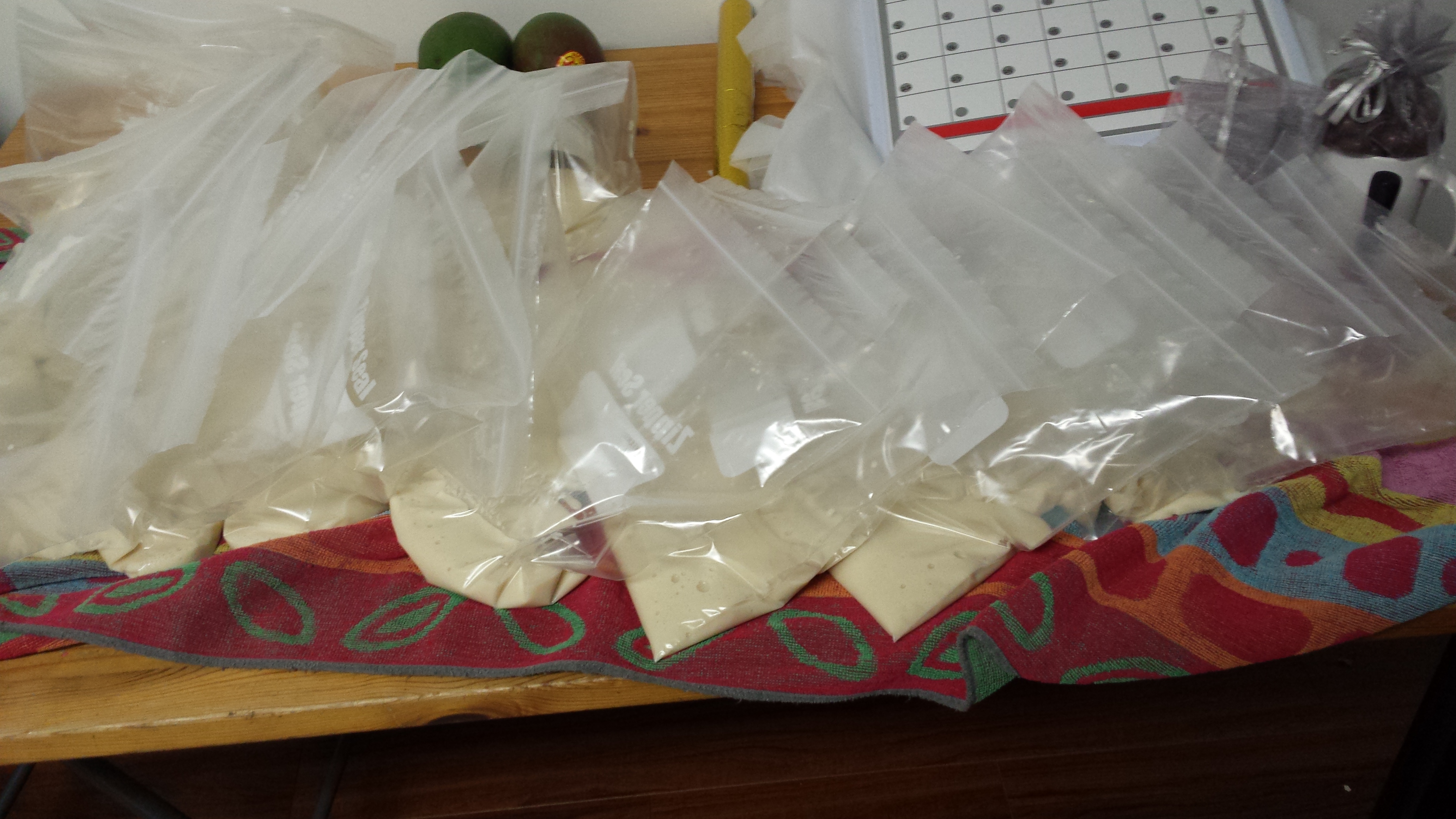
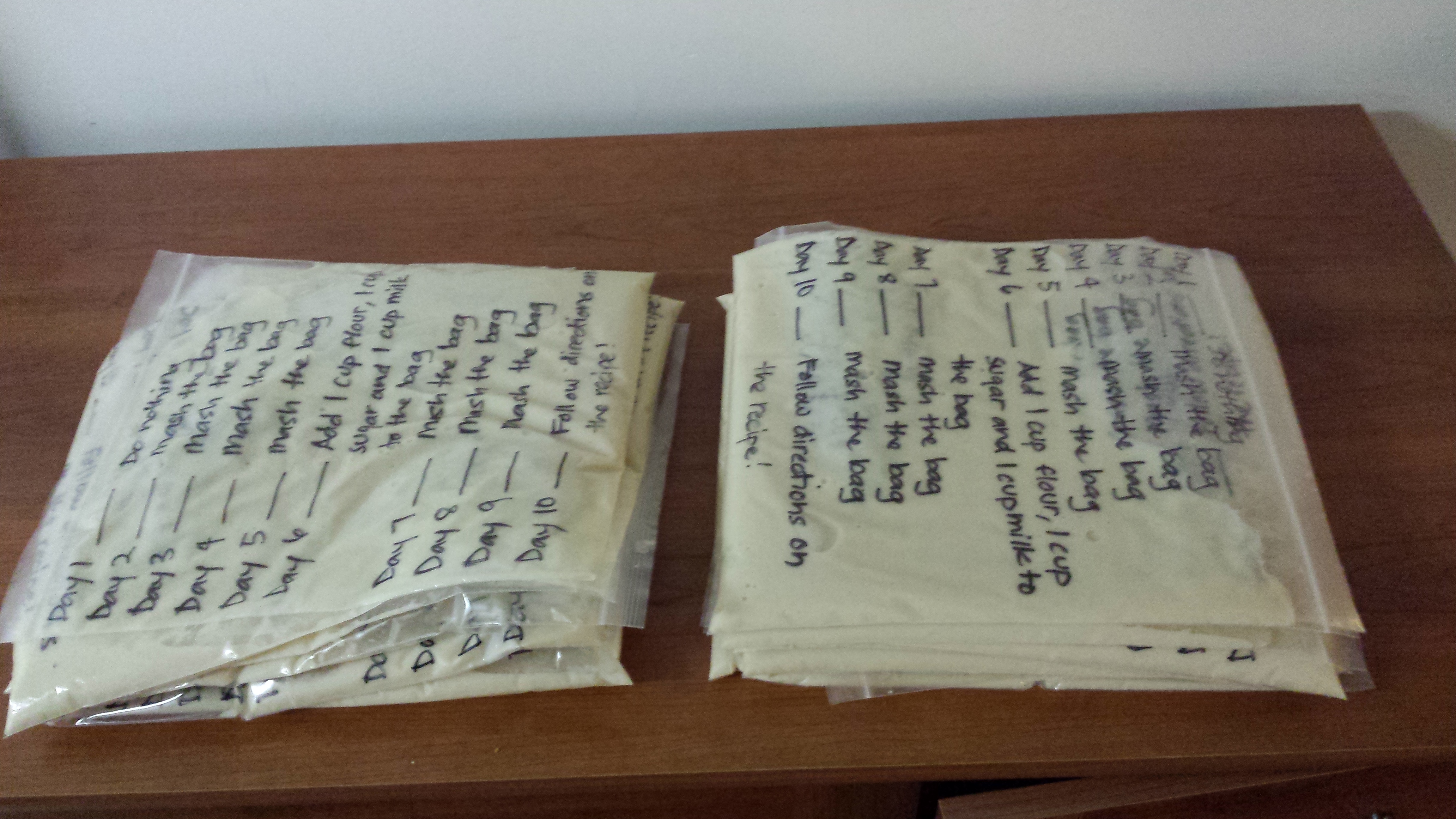
As day 10 finally arrived, and after divvying up the starter, I made my first loaves of Amish Friendship Bread. I read on a blog somewhere that, “it’s the smelliest process for the most divine bread ever” and sure enough as this bread was baking our apartment filled with its sweet aroma, a welcome change to the scent of the starter. My housemate came home in the midst of my baking extravangza and was pleasantly delighted by the smell. The recipe made 2 loaves, so I brought one to the potluck for the “stoodents” and kept one at home for a party we were hosting later that week. The blog did not lie, once I got to taste the bread, which had called for pudding powder to make it more moist, I could immediately tell it was the most delicious sweet bread I had ever eaten.
I still have some starters in my freezer, if this post has whet your appetite and you’d like to try to make some Amish Friendship Bread, let me know and I’d be happy to send you a starter.
What I’m reading these days
As many of you know, I’m an avid reader. I have so many books on the go, and so many more that are in the queue to be read. This year some friends of mine started a book club, and it’s been a lot of fun gathering with this group, and the books we’ve been reading have led to some lively discussions.
Here’s what we’ve been reading:
October: Beautiful Ruins by Jess Walter
November: The Interestings by Meg Wolitzer
January: Americanah by Chimamanda Nguzi Adichie
February: The Rosie Project by Graeme Simsion
March: Perfect Girls, Starving Daughters by Courtney Martin
April: The Unlikely Pilgrimage of Harold Fry by Rachel Joyce
May: The Beautiful Things That Heaven Bears by Dinaw Mengestu
Some notable books on that list have been January’s book and March’s book.
January’s book, Americanah was enlightening to see and understand the perspective on an international student from Nigeria. I have spent nearly the entirety of my life in Canada and I often have a hard time fully understanding the experiences of those who newly arrive in North America. I found the main character’s perspective and humour insightful as she names and wrestles with concepts and concerns that are far removed from her home context. Her perspectives on race and culture as a Non-American Black were intriguing and gave voice to things I’ve felt or experienced but struggled to name aloud.
Since reading Perfect Girls, Starving Daughters, I can’t stop talking about it. While reading it: I often wanted to curl up and cry for all the women in my life whose lives reflect those depicted in this book; I surprisingly found stories that deeply resembled my own; and my eyes were opened to how these attitudes and behaviours have stolen life from so many of the lovely and beautiful women in my life. And though the bulk of the book was heavy-laden with sad stories and statistics, it ended on a hopeful note, with encouragement to get help and support. I was surprised as one of the chapters discussed the author (and my) generation’s deep spiritual hunger; naming that ours is amongst the first of generations where spiritual beliefs or foundations have been absent and in the place of having belief in and a relationship with God our generation has made their own gods that we center our lives around, one being eating disorders. This idea isn’t exactly new to me, in fact part of the reason I work in ministry is because I see this everyday; the way people orient and center their lives around something that leads to death and I long for them to reorient their lives toward something that would give them life rather than take it away. But I was surprised to see the author name this as well, and invite her readers to fill that spiritual hunger and how that can give them the strength and support to conquer their disorders and reclaim their lives.
And as always, there’s more that I’m reading, but I’ll include some of the others in another post.
Tubing redeemed & other stories
Often when I tell the story of how I got connected with IV, I start it this way:
In my first year of university, I went on the worst retreat of my life…
It was a regional retreat at Muskoka Woods that was for college and career groups from across Ontario, and I went with my church’s college and career group. I won’t go into all the gory details, but I can say that after this experience, one thing was clear: I wasn’t giving up on Jesus or Christian community as a whole, but I knew this group was no longer a good fit for me nor was it a place that would equip me for the mission I felt God had called me to (reaching out and being witness to my fellow design students). I was deeply grieved by this realization, this was the first church I had joined that I really felt connected to and the thought of leaving and starting anew was not something I was looking forward to. In the end, I felt called to stay at my church, but to seek out a Christian community on campus that would be present for me when I was on campus and equip me with the skills and training I needed to be missional amongst my classmates, and after a few divine appointments, I found IV. (There’s more to this story, but I’ll save that for another post.)
One of the many painful memories of the above mentioned retreat was that it housed my first tubing experience. I’ve wanted to go snow tubing ever since I knew it was a legitimate activity and I was through the roof with excitement that we could go tubing during this retreat. The lead up to the tubing was long and my patience was tried as I waited for my slow moving retreat roomies to bundle up so we could go. I could have guessed with their lackluster attitudes about being outside that these folks may not be the best company, but I was so excited it didn’t seem to matter. We finally got outside, and I went down the hill which was much smaller than I imagined a total of 2.5 times, and then my bored and cold roomies went inside and I was left to follow them. Had I known it was to go inside and do nothing, I would have stayed out tubing, but I was young and female bonding and FOMO (fear of missing out) were way too important to me.
Since this time, I’ve had those friendships and retreats in general be redeemed, but it wasn’t until Ryerson’s winter retreat this past January, that God was able to redeem tubing for me. I haven’t always had the best experiences with camp in the past, but I was excited by the possibility of having a winter retreat at OPC, especially since I had students who had worked at camp in the summer coming and I also had built new relationships with camp staff at the National Staff Conference. When it came time to select activities, I was thrilled at tubing was an option. And so, ten years after that first retreat (almost to the exact date), tubing was redeemed for me. As I sped down the hill (so many times I lost count), I was struck by how “right” it felt to be there at OPC, with these students and the alumni that joined us, and that God was so good to give me this redeeming experience with them.

Another highlight from this time include an interactive study of the Rich Ruler in Mark (Mark 10:17-31). The text challenged us as we considered that sometimes we can make the blessings that God has given us into idols and how we are called to let them go in order to put God first. We applied this passage by identifying what we root our identities in or what binds our decisions and then depict that thing in a creative way on a piece of paper. Some of the students drew pictures, some wrote poems, one who was an English Masters student wrote a 6 page paper! After we shared our answered with one another, we then put our papers in the fire as a symbolic representation of putting God above those things. It challenged the students as they wrestled with what it would mean for them to actually allow God to come first before those things.

A new year and a new season
2015 started on a restful note. For the first time in years I wasn’t working at a conference after Christmas until the New Year, and I was able to spend some time relaxing and recouping after a busy season. The first weekend of January, I went away with my regional staff team for a time of prayer and planning for the new year. We went to an air b & b in Manila that was once a church. It was a lot of fun exploring the b & b and finding remnants of the church, like a bedroom in the bell tower and a beautiful stained glass window in a bathroom. The time away offered good perspective on the year ahead, and good space for us as a team to support one another as we shared the challenges that we face in the upcoming season of ministry.
The past few months for me have been spent in discernment about my time with IV and what the future could look like as I entertained a host of possibilities. The discernment period ended with an offer to a new 3-5 year contract which I will say more about in future posts.
January also marked a milestone birthday for me, and I celebrated with samosas and mimosas and a throwback photo booth where I recreated some photos from my past with some friends who have been in my life since my childhood and other significant moments.
As I enter into a new season of life and ministry, I’m struck by the significance of possibility and also that I find myself at the same age as Jesus when he began his formal ministry. I am curious to see what this next season of ministry will hold for me.
National Staff Conference
Every three or so years, IVCF gathers all of their staff from campuses, camps and the national service centre for a time of training, fellowship and vision casting, as we see where God will lead us in the next season of our various ministries. The theme of this year’s National Staff Conference was “Good News Life”, and it centered on how we are called to live lives of witness with teaching, story-telling and new resources to share the gospel in our ministry fields.
Becky Pippert, author of Out of the Salt Shaker Into the World was the primary speaker and teacher at this conference, and she led us through a seeker study series called “Uncovering the Life of Jesus”. The material follows a format similar to an inductive study with suggested questions to help people look for the answers within the Scripture. I’ve led a few other seeker studies called Groups Investigating God (GIGs) on campus in the past, and I’ve often found the gap between participating in a study and leading one is very big. These GIGs have been effective in reaching seekers where they are at, but often requires a whole different set of training and preparation materials. However, the Uncovering the Life of Jesus material has been formatted in a way that the gap between participating and leading is much smaller, so there’s a higher possibility of the material reaching multiples of people quickly. Since this conference, I’ve led this material with my student leaders and there have been a few people we’ve approached about doing this series with us (more on that in another post).
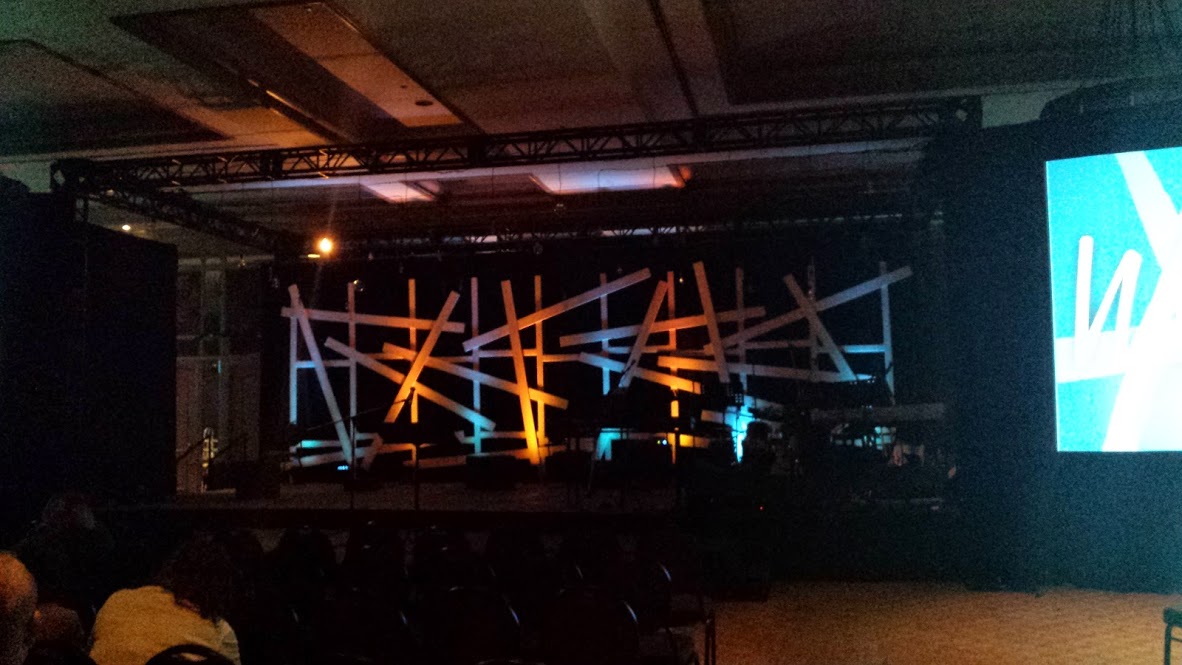
Since National Staff Conference only happens every few years there’s a lot more that is part of this conference; like dramas, worship, story-telling, silent auction, bookstore and stage design. This is a time when the many hidden skills and talents of IV staff come to the surface as they get to use some of their skills and schooling. For me, I was invited to be part of the stage design team with SFU’s IV staff and my dear friend and Ryerson alumnus Barron and the ever-talented IV graphic designer Rebekah Rotert. I enjoyed working on a team with these two, but re-entering the design world was not a pleasant experience for me. But, as a team we produced a beautiful stage design and designed an interactive marquee that people would engage throughout the week. The premise was that people would seek out light bulbs throughout the spaces of the conference and common areas (like the front desk or Starbucks) and if they retrieved a light bulb they would screw it into the display. It was a marker to show that each effort brings forth light, but it truly is a thing of beauty when all the bulbs are found and light up the whole display. It was a lot of fun seeing the piece slowly light up throughout the week.



Though I was pretty exhausted after coming out of a busy season of ministry and a challenging period of discernment, I found myself receiving a lot during this conference and have seen some of the fruit of this teaching in my own life and on campus.
 The Arch