
Looking ridiculous for the Kingdom
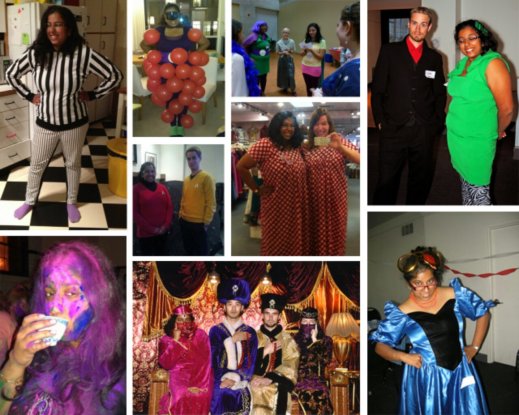
I often joke with my staff partner that he should rename his newsletter, “Ridiculous for the Kingdom”, and share stories of all the ways he, who is normally very well dressed, chooses to look completely ridiculous for the sake of caring for and investing in new students.
And then as I was browsing through some of my photos I realized that this is also true of me. Now, if you were to talk to some of my oldest friends, they would tell you that I am not opposed to looking ridiculous, but as I have matured, the opportunities to look ridiculous with my peers are few and far between. Which is why I love working with students. Here’s a collection of times I’ve looked ridiculous for the Kingdom in the last couple years.
Salted cookies, secret giving and sowing seeds
…are just some of the fruits of this fall’s Manuscript study.
We have spent this fall studying Matthew 5-7, the Sermon on the Mount, and this year we (my staff partner and our student Ieadership team) hoped to see students more actively living out the application of the Scripture.
So we thought through how we could apply the Scripture with a combination of thought provoking questions, simple illustrative activities, and tangible take-home challenges. Here’s a quick summary:
week one: We wrote out the Beatitudes in our own words.
week two: During our study we invited students to have a piece of gum that lost its flavour quickly. Then we gave the students a salted chocolate cookie which they ate and found delicious, after which we gave them a second cookie to give away (and left it open to see how they would go about doing that).
week three: We gave each person a plastic plate and invited them to write with a marker a word or phrase to represent something they needed to release to God. Then had them dip their plate in a bowl of water and as it washed away see it as a symbol of God’s forgiveness.
week four: We discussed what it would look like if we actually followed through with the words that we say and the good intentions that we have.
week five: We engaged in a prayer mapping activity to help us love our enemies and pray for those who persecute us.
week six: We encouraged students to “give in secret” by choosing to give and serve sacrificially.
week seven: Using the Lord’s Prayer, as a model, we spent some time interceding for each other and the campus.
week eight: We sent the students out to try a new prayer practice to help release anxiety.
week nine: After studying about not judging others, we spent some time reflecting on places where we have been too judgmental and working through the next steps toward repentance and where possible making restitution.
week nine: Through a different prayer mapping activity, we invited students to map out an answered prayer, making note of whether or not God answered in the ways we expected. Then we invited them to ASK God for something big, holding it open-handed to the ways God may answer it or in the timing He takes to do so.
week ten: After spending some time reviewing all the ways God has spoken to us through this sermon, we sent the students out with a packet of herb seeds so that they could grow in their understanding of how things grow (and better understand Jesus’ use of growing imagery) and also bless others with the herbs they grow, so that the impact of our study group goes beyond those participating in the study.
There are so many stories to share about how God has been working in the lives of these students who have gathered to study scripture with us, but here are just a handful:
• a student who is brand new to our community chose to: share the gospel for the first time to a stranger on the GO train (after giving that person a cookie), give his time sacrificially to serve his church, invite his friends to come to bible study, learn how to lead a manuscript study and co-led a study with me, and be actively involved in our community even though he has a long commute home!
• In fact, I found out in week seven, that half of the students who regularly attended our tuesday study chose to stay on campus for the study even though their classes ended hours earlier and they would then commute home to Pickering, Brampton, Scarborough, Markham or Mimico after the study during rush hour!
• Two students would come downtown just for the study (from Mimico and Markham) on days they didn’t need to come downtown for class! One of these students told me, ‘well, I would come downtown for a two-hour class, so I’m willing to come downtown for this’.
• And there have been so many encouraging stories of how the students have been actively choosing to love and serve their friends, family, roommates, and classmates in sacrificial ways coming out of choosing to apply this Scripture! Praise God!
More than friends with manuscript study
I have a confession to make: I hate manuscript study.
Or at least I used to.
When I was a student and my staff worker led me in one method of an inductive style Bible study called manuscript study, I was confused, at best. The next few times, I grew to loathe it, especially after a long day of lectures. I wouldn’t say much to contribute to the discussion during the study and I rarely left feeling like I had gained anything of value. And when I would meet with my staff worker, I would tell her all the reasons why I hated this method, and she would patiently listen and try and cast vision for why it could become a method I could grow to love…
Now, with a lead up like that, you probably are expecting me to share a story about how my eyes were opened and I began to see the value of manuscript study and deeply come to love it. After 3 years of studying scripture in this way as a student, a mission trip with the purpose of teaching local students of one of our sister movements how to do manuscript study, an internship with Intervarsity, and 3 years as a staff worker; I still didn’t love manuscript study.
To be clear, at this point, I liked manuscript study; if I tried to equate my relationship with manuscript study to a romantic relationship I would say that I liked it as a friend, I saw its value and would appreciate its company but would always be on the lookout for a style that was a better fit for me.
But what did that mean for ministry with students? Where my staff worker had a host of students who disliked manuscript study, I found myself with the opposite situation where I had a community of students gathered who LOVED manuscript study. So I would spend my time equipping students how to lead a manuscript studies so I could free myself up to pursue other creative ministries.
Last year, I found manuscript studies particularly draining. And after some time reflecting, I realized it was because we had let this method become routine and predictable. We would spend hours engaging the text intellectually, but not allow the truth of the text penetrate our hearts and we would rarely find ourselves applying the scripture beyond our study time. And I realized that we couldn’t keep on going this way, and actually there was room for some of those creative ministries to be included in our bible studies.
So we pursued manuscript studies in a new way this year, and in addition to amazing stories of God speaking new truths to students and students choosing to actively apply the Scripture in their lives; through the fusing of God’s word lived out creatively, it happened: I became more than friends with manuscript study.
 The Arch